
Reproduction (IB Topic D3.1)
Essential Idea(s): Formation of haploid gametes is required for sexual reproduction. Pregnancy and birth are then regulated by interactions between maternal and fetal hormones and systems.
Unit Length: 6 Lessons (+4 AHL)
Guiding Questions
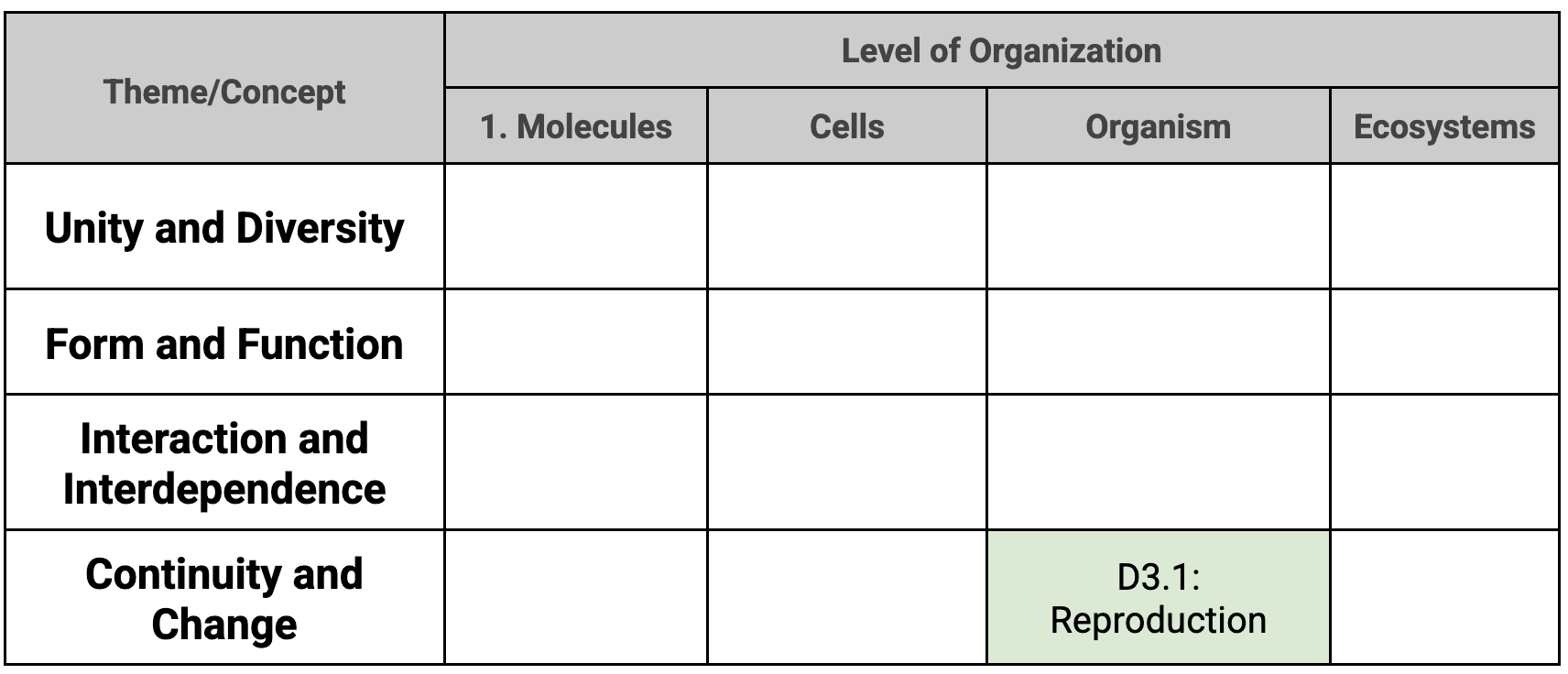
◊ How does asexual or sexual reproduction exemplify themes of change or continuity?
◊ What changes within organisms are required for reproduction?
Materials:
| Self-Teaching Slides (SL) / Self-Teaching Slides (AHL) | Quizlet Vocab Sets: Reproduction in Humans / Reproduction in Plants |
| Teaching Slides (SL) | Notes Template (SL) / Notes Template (AHL) |
| IB Statement(s) and Objective(s) |
|---|
|
D3.1.1: Differences between sexual and asexual reproduction
D3.1.2: Role of meiosis and fusion of gametes in the sexual life cycle
D3.1.3: Differences between male and female sexes in sexual reproduction
D3.1.4: Anatomy of the human male and female reproductive systems
D3.1.5: Changes during the ovarian and uterine cycles and their hormonal regulation
D3.1.6: Fertilization in humans
D3.1.7: Use of hormones in in vitro fertilization (IVF) treatment
D3.1.8: Sexual reproduction in flowering plants
D3.1.9: Features of an insect-pollinated flower
D3.1.10: Methods of promoting cross-pollination
D3.1.11: Self-incompatibility mechanisms to increase genetic variation within a species
D3.1.12: Dispersal and germination of seeds
|
|
Additional Higher Level Topics
B2.3.10: Adaptations of sperm and egg cells
D3.1.14: Spermatogenesis and oogenesis in humans
D3.1.15: Mechanisms to prevent polyspermy
D3.1.16: Development of a blastocyst and implantation in the endometrium
D3.1.17: Pregnancy testing by detection of human chorionic gonadotropin secretion
D3.1.18: Role of the placenta in fetal development inside the uterus
D3.1.19: Hormonal control of pregnancy and childbirth
D3.1.20: Hormone replacement therapy and the risk of coronary heart disease
|
|
Activities: ⓟ = podcast / ⍰ = inquiry 5 / ⓦ = Write it / Ӕ = The academy / Ⓡ = Read it |
|---|
|
Activities for Reproduction in Humans: ⓟ: Radiolab – The Primordial Journey (💁/ 👭 max 3) Listen to this RadioLab podcast on reproduction (skip ahead to 1:55 to begin). Together with your fellow podcasters, respond by discussing: 1) The basics of gametogenesis – what are gametes, and how do they form?; 2) If anything from the podcast surprised you.
ⓡ: Reproduction Revolution – Turning Skin Cells into Sperm/Egg (💁/ Podcast: 👭 max 3) Biotech research is on the brink of being able to do something quite amazing: take a skin cell, induce it to reverse differentiate, then differentiate it into a sperm or egg cell. Connect your knowledge of stem cells with reproduction, and take a glimpse into the future of biotechnology. Respond by answering: 1) How do sperm/egg cells typically develop; 2) What are induced pluripotent stem cells?; and 3) Why would it be useful to reverse engineer a skin cell into a reproductive cell?
ⓡ: “The Pill”…Now for Women AND Men (💁) Imagine a contraceptive pill for both men and women. That reality might not be too far off. Read about researchers efforts to produce a drug that can shut down the sperm’s ability to swim inside the uterus, then respond by discussing: 1) What capacitation is during fertilization; 2) How this drug might potentially affect capacitation; and 3) How you think society might respond to the idea of both men and women being “on the pill”.
ⓟ/ⓦ: The Mystery of “Semi-Identical Twins” (💁/ 👭 max 3) A recent case swept the medical community when a routine ultrasound + blood test revealed twins that were neither identical nor fraternal…but somewhere in between. Read about the case and discuss: 1) What typically happens to embryos in identical and fraternal twins; and 2) What unique steps happened in this case; and 3) What made the case a unique example of polyspermy.
ⓟ/ⓦ (+NOS): Woops?! Does ‘the pill’ make men infertile? (💁/ Podcast: 👭 max 3) Science sometimes has unintended consequences. As effective as the female contraceptive pill has been, its widespread use has proven to be a common suspect in problems ranging from “intersex fish” to infertile human males. Some suggest that the pill might be responsible for the recent “male fertility crisis” – the incredibly rapid rate of decline in both quality and quantity of male sperm in recent decades. Are these accusations misguided? Did we misstep in our use of the female contraceptive pill? Are alarmists spoiling a perfectly good scientific invention? How should science approach the possibility of unforeseen consequences? Respond to these problems, using ideas from 11.4.A1.
ⓡ: The 4-year old trapped inside a 14-year old’s body (💁) What’s the earliest onset for puberty? If you’re unlucky enough to have a mutated luteinizing hormone gene, it can happen as early as 2 years old…which obviously presents some problems. Read about one such case, and discuss: 1) How do hormones regulate life phases, e.g. puberty?; 2) What exactly do hormones do during puberty? (use specific terminology from the unit); 3) How can single mutations result in completely unique lives and medical cases, as described in the story?; 4) If you think screening for such cases should be mandatory for expecting parents.
ⓟ/ⓦ: TED Talk: The birds and the bees are just the beginning (💁/ 👭 max 2) People often know very little about sex, and even less about the evolution of sex in the natural world. From detachable penises to “traumatic insemination”, there are wildly strange sex habits in the animal kingdom. Learn about some of them here, then discuss: 1) How have different approaches to sex evolved in the animal kingdom?; 2) What is meant by the expressions, “eggs are expensive, and sperm is cheap?” and how do these influence the evolution of sex?
Just for Extra Practice: Menstrual Whiteboarding ————————————– Activities for Reproduction in Plants: Ⓛ: Flower Dissection (💁 / 👭 max 2) This is one of the best ways to get familiar with the various parts of a flower. Find yourself a bouquet, choose two flowers, and follow the directions in the slideshow. Complete the questions on the final slide (you can either record your answers or write them out – submit either to G. Classroom!) Watch an example flower dissection here.
Ӕ: The Academy – Angiosperm Reproduction (💁) Record a Khan Academy-style video explaining the anatomy and physiology of plant reproduction (go here for inspiration). Be sure to explain both the parts of a flower as well as those of a seed, and the key biology behind the way they work together to reproduce.
ⓡ: How Flowering Plants Changed the World (💁) There is perhaps no group of living organisms as broadly iconic as flowers: humans identify them with everything from love and passion to death and curses. This isn’t exactly surprising — flowering plants have adapted to capture the attention of all kinds of animals, including humans. In doing so, they changed how much of the living world works. Read this article on how those changes unfolded throughout history, and discuss: 1) What did the natural world look like before and after the arrival of the angiosperms? 2) How old are the angiosperms, and what tools are scientists using to answer that question? 3) How did angiosperms come to evolve and dominate in a world of conifers, ferns, and mosses?; and 4) What role did dinosaurs play in this evolution?
Ⓛ: Germination Inquiry Lab (💁 / 👭 max 2) Take on a simple task: Design an experiment to test the effect of a variable on seed germination, plant growth or response This could range from anything from acid treatment to thermal scarification. You can use any seed of your choosing, and design the experiment in any way you like. Submit a video or write up, briefly describing the variables you were investigating and the results from your lab. Include video/photos of your plants before, during, and after germination.
Ⓛ: The Baby Plant Project (💁 / 👭 max 2) Take on the role of a low-stakes parent: grab some seeds and make a “baby book” to record the development of your baby seeds as they sprout into a green plant. Document the key stages of development with a video or written document, in which you explain the anatomy and physiology of the plants in each phase of their development. |